The sample novel#
The ROM holds one novel made with Sound Novel Tsukuru, in two parts: 寺田憲史 サウンドノベル劇場「夏の樹に棲む妖精」, Kenji Terada's sound novel theatre, Natsu no Ki ni Sumu Nymph: "the nymph who lives in the summer tree". The title writes the fairy as 妖精 and glosses it ニンフ, nymph. It is a summer love story and a ghost story, told by a young man who comes back to the tree where he met a girl ten years before.
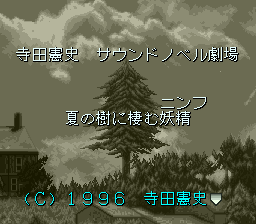
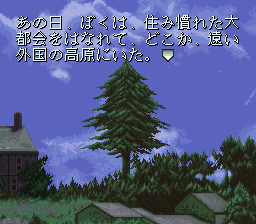
- To read it: Game → Sample Game サンプルゲーム → part one ゼンペン or part two コウヘン. It always plays from the ROM, whatever you have done in the editor (Getting started).
- To open it in the editor: Data → Sample Load サンプルロード copies one part onto the cartridge's drive, in place of the novel there (Getting started). Save your own novel to a memory pack first if you want to keep it.
- It shares the one saved reading: reading a part past a save point replaces the reading kept for your own novel (Playing and testing).
This page gives the novel's shape, what it uses and how it builds its scenes, so that you can learn from it. It is read from the novel's own files (Tools/snt_novel.py dump), not from a playthrough, and quotes a line at a time at most: the story is someone's work, and best read on the cartridge.
At a glance#
| Part one ゼンペン | Part two コウヘン | |
|---|---|---|
| Start card | SC02-01 | SC00 (the title) |
| Cards | 46, and END | 25, and END |
| Steps | 782 (the longest card 54) | 910 (the longest card 90) |
| Texts | 218 | 228 |
| Text choices | 9 (5 two-way, 4 three-way), and a play-again choice | 4 (2 two-way, 2 three-way) |
| Items | none (two deleted records) | 25: 7 flags, 5 for the title, 13 for the special thanks |
| Item steps | none | 7 Set Item, 9 item branches, 5 Show Item |
| Save points | 8, each just before a choice | 3 |
| Endings | one early ending; the last card says to be continued | 3: two early, one true |
| Pictures | 17 backgrounds, 6 silhouettes | 19 backgrounds, 6 silhouettes |
| Songs | 18 of the 60, in 38 Start BGM steps | 25, in 41 |
| Effects | 20 of the 256, in 58 Start SE steps | 30, in 119 |
The cards are named by scene: SC03-01 is scene 3's first card, SC03-01A and B the cards for the choice's sides, and an E marks an ending. The texts are numbered in reading order with the same letters (004A-1, 014B-1), and a few extras are named for what they are (ETC001, the gloss; コピーライト, the copyright line). A scheme like this one keeps a novel of hundreds of texts findable in the editor's lists, where only the names show.
The story#
The story of both parts (spoilers)
Part one. The narrator remembers a summer when he was eight, at his uncle's house in the highlands, under a huge old fir. There he met Natsuki 夏樹, "summer tree", a girl a year younger, his fairy. She loved the sound of the bells he collected, and the best five of them the two called the Five Fine Sounds いい音五人衆. Ten years later, a message from Natsuki over the computer network brings him back. She meets him at the station, seventeen now, and leads him to the tree and into a strange house. There the truth comes out: Natsuki died the day after he left, and her spirit, which the old tree's spirits took in, has been speaking through her younger sister Natsumi 夏実, in a house the spirits made for her in the likeness of her own. To set Natsuki free, the two of them must find the five bells. Part one ends as the search begins.
Part two. The search through the house's rooms. Natsumi vanishes; two fairies of the tree who can read minds, Poge ポゲ and Fugu フグ, help him find four of the bells; a prince of the tree's fairies ミーハー王子 and his followers are after them, and camphor ショウノウ, which fairies can't bear, keeps them off. The true ending finds the last bell, rings the five together, and lets Natsuki rest.
Part one: the shape#
Part one is a single line with branches that rejoin it. Each choice gives a card or two of its own, then jumps back to the next scene, so every reading meets the same events. Only the first choice can end the story.
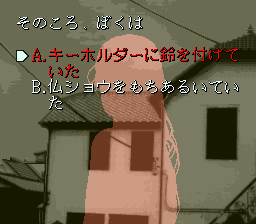
- The first choice decides everything. Asked what the boy carried, the reader picks the little bells on his key ring or a Buddhist priest's bell. The bells lead on into the story. The Buddhist bell ends it in three texts: he gives the bell to the girl, she goes, and an epilogue ends on END. Then a card asks もう一度遊びますか?, "play again?": start again from the beginning goes back to the title card, stop to
END(Branches and items). - The other eight choices are for flavour. They change what he says or does at a moment (how he answers Natsuki, how he steps off the train), then meet again. At the station, one answer, "I suddenly wanted to go home", only earns a page of embarrassment and asks the question again.
- A save point just before each of those eight choices means that a reading continued later starts on the choice, and the reader can take another side. The first choice has none.
- The last card has the narrator ask which room to try first, types the title and (後編)に続く, "continued in part two", waits 15 seconds, and stops on a key wait. It has no jump after it.
Part two: the shape#
Part two is two hubs and a key item, made with seven Yes/No items as flags (Branches and items).
- The title card, then a save point, then the first hub: three doors, right, ahead and left. Each door's card first asks its own flag. A door already opened shows この部屋はさっき入ったな。, "I've been in this room already", and returns to the doors; a new one plays its scene, sets its flag and returns. The door ahead and the door on the left must both be opened, in either order: each one's card checks the other's flag, and the second of the two leads on. The right-hand door ends the reading (ending 1).
- A choice: rush to Natsumi's rescue, or keep calm. Rushing ends the reading (ending 2). Keeping calm saves the reading and opens the second hub.
- Three rooms, each flagged the same way. The farthest room sets the item camphor シヨウノウ. After each room a choice asks: another room, or go after Natsumi?
- Going after Natsumi tests the camphor: without it, the reading joins ending 2; with it, the story goes on to the prince and the true ending.
So part two's hubs are the patterns of Branches and items: a flag for a place visited once, flags for several things done in any order, and an item that a later branch asks for. Its three endings close alike: the last text starts a new page, runs eleven empty lines and types The End at the foot of the window; a Wait of 10 to 20 seconds and a Wait for Key follow, and no jump. There is no play-again card here.
What it uses#
Together the two parts use 37 of the 91 pictures, 33 of the 60 songs and 44 of the 256 effects. The catalogue's tables say which, in which part and how: The pictures (with the colour variants each is shown in) and Music and sound (with the tempos).
- Pictures. The great tree タイボク is part one's home: its first card, its title, and every return to the past. Part two lives in the house: doors, corridors, stairs, rooms, the storeroom, and the forest and the lake behind it. Plain ベタ is everywhere, as a blank between scenes and behind silhouettes. Natsuki is ジョセイB, a woman's head and shoulders, in red, grey and light grey; the young Natsuki is the girl オンナノコ; Poge and Fugu are the pair ヨウセイC, and the figure in a cloak マント stands over Natsumi in the forest.
- Colour variants. Every variant from A to F is used. Sepia (C) is the past, night (B) the train, the doors and the windows; Natsuki's silhouette changes with the moment: red (D), grey (E) or light grey (F).
- Songs. Part one leans on the music box オルゴール, Demise B シュウエン B and Jingle B; part two on Jingle N, the music box, Demise A and Thinking it over. It uses every Tempo setting: Memories A オモイデ A, the title's song, plays at normal, fast and very fast in different scenes.
- Effects. The bells are the story's sound: the little bells スズノオトA and B ring 28 times across the two parts, and the Buddhist bell ブッショウ six times, all on the early ending's side. Part two opens and shuts doors (35 times) and walks the corridors in leather shoes.
How it is built#
The opening and the title card#
The first card clears everything (music, effect, pictures, text), puts the tree on screen in full colour and fades in. The first text begins: あの日、ぼくは、住み慣れた大都会をはなれて、どこか、遠い外国の高原にいた。 ("That day I had left the big city I knew, and was on a high plateau somewhere in a far-off country.") Then a yellow fade キイロ takes the screen out and brings the same tree back in sepia, the past. The next text is set in a narrow window in mid-screen and typed slowly; then the cicadas start, and a Wait lets them sing for eight seconds.
The second card is the title card: the title's song, the cicadas again, a text window over nearly the whole screen, and three texts. The title is one text, placed by blank lines and spaces; the gloss ニンフ is a second; the copyright line, (C)1996 寺田憲史, is a third, shown in blue (Show Text's colour). A wait, a key wait, the song fades out, and the story starts. The steps goes through the opening step by step.
A gloss by hand#
Sound Novel Tsukuru has no ruby, the small reading printed over a word. The sample makes its own: the gloss ニンフ is a text of its own, ETC001. After the line that ends in 妖精, a Text Position step テキスト ヒョウジカイシイチ moves the writing point up a row and over the word; Show Text writes ニンフ there at the fastest speed; a second Text Position takes the point back down to the line, and the sentence ends with a text of its own, と出会った…… ("… met"), at the slow speed again. The title card reuses the same ニンフ over the title's 妖精 (Texts).
The title of part two, in items#
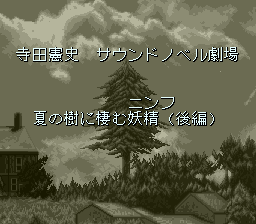
Part two's title card shows its title with five Show Item steps, not a text. Five Name items, 000 to 004, hold 寺田憲史 サウン, ドノベル劇場, 夏の樹に棲む妖精, ニンフ and (後編), eight characters at most each, placed with Text Position steps between them. A text would have done the same. Part two's items also hold the special thanks: thirteen more items with the names, which its steps never read; the staff roll shows the same names from its own texts (Behind the scenes).
Light, colour and figures#
- A flash is a fade out and straight back in, through white or yellow. As Natsuki takes his hand in part one, four flashes, yellow and white in turn, each with a thunderclap カミナリA, run under a Background Effect; then Background Colour tints the picture yellow for the "whirlpool of light", and base colour puts it back when it is over.
- A world of light is plain ベタ in yellow (D) with Natsuki's silhouette in light grey (F) over it.
- A flicker is the same silhouette set again three times in a row, in F, E and F after D, then cleared: Natsuki seen and not seen.
- Black text on white. Behind part two's right-hand door, light blinds the two: the screen fades out to white, and the next five texts are shown in black (Show Text's colour). Part two does it in four places, ten texts in all.
- A montage. In part one, as Natsumi tells what became of Natsuki, a picture changes with each text, nearly all in sepia: a doll, the girl over it, a fairy over the tree, the girl before a mansion, a couple under the tree, two sisters.
Sound that tells the scene#
- The choice you hear. Part one's first choice is about bells, and each side rings its own: the little bells before the question and on their side, the Buddhist bell six times through the other.
- An effect for something else. Behind a door in part one he hears a sizzle "like someone cooking", and Natsuki is cooking: the effect is welding *ヨウセツB. Read the effects for their sound, not their names.
- Endless effects under the text. The cicadas *セミ sing under part one's summer, the fire *モエルB crackles in the fireplace scenes, high heels *ハイヒールG come running as Natsuki runs to meet him at the station, and a Stop SE, or the next effect, ends each when the moment is over.
- Tempo for mood. The same song serves several scenes at different speeds: the music box very slow, Memories A very fast.
Pace#
- The text speed changes all the time. The story is typed at speed 03. The title card and the line before it are at 12, the endings at 06 to 12, and a few lines of shock at 15 and 16, the slowest. Every choice is shown at 01, the fastest, set just before the choice step and set back on each side, so the question appears at once.
- Waits, 139 of them, nearly all of one to five seconds, sit between pictures, songs and texts. The endings hold their last page for 10 to 20 seconds before the key wait.
- Key waits are mostly inside the texts (the ♡ mark), so a text of several pages needs only one step; a Wait for Key step is used where a page must end before a picture or a sound changes.
What to learn from it#
Fan-made reference material, one of the Eschaton Games Tsukuru guides. Not affiliated with the publishers of the titles it covers. Corrections and questions: contact@eschaton.games.