Behind the scenes#
Who the cartridge says made Sound Novel Tsukuru, its staff roll (itself a novel, on a drive of its own), the cartridge and its save, what is left over in the program, and how the study behind this guide was done.
The logo, the title and the staff roll#
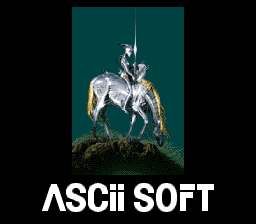
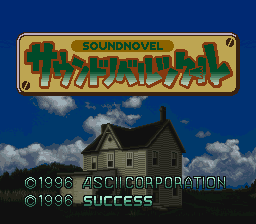
Switched on, the cartridge checks for a memory pack, shows the ASCII logo, checks its battery memory (エディットデータチェック中, "checking the edit data": Saving and sharing) and comes to the title, with two copyright lines: ©1996 ASCII CORPORATION and ©1996 SUCCESS (Getting started). A goes on to the main menu. Left alone, the title runs the staff roll: スタッフ ("Staff") over the title's picture, then the names, a role at a time, over pictures from the library.
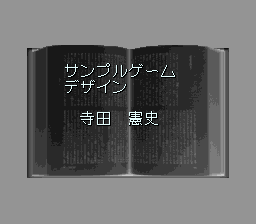
The roll, as the game shows it, in its order:
| On screen | Role | Names |
|---|---|---|
| グラフィック デザイナー | Graphic designer | 今 正史 |
| アシスタント デザイナー | Assistant designers | 宇井 照子, 町田 孝幸 |
| プログラマー | Programmers | 笹 瑞穂, 小嶋 俊晴 |
| サウンド プログラマー | Sound programmer | 磯田 重晴 (Shigeharu Isoda) |
| サウンド ディレクター | Sound director | 有坂 光弘 (Mitsuhiro Arisaka) |
| サンプルゲーム デザイン | Sample game design | 寺田 憲史 (Kenji Terada) |
| マニュアル | Manual | 桧 明日香, 竹ノ下 純子, 金川 加奈子 |
| スペシャル サンクス | Special thanks | 野坂 信介, 鈴木 毅夫, 下地 一史, 山田 英治, 竹本 賢太郎; 中西 保臣, 川島 俊治, 秋山 森彦, 岩片 烈; 加藤 顕, 永峰 孝紀, 堀合 将仁; 木田 敦子; 永倉 麗子, 中川 クミ |
| 撮影協力 | Photography by courtesy of | 三島食品工業株式会社; 『デ・ラランデ邸』 |
| スーパーバイザー | Supervisors | 吉成 隆杜, 青山 豊 (Takato Yoshinari, Yutaka Aoyama) |
| ディレクター | Directors | 池田 国人, 高見 大三郎 (Daizaburou Takami) |
| プロデューサー | Producer | 川村 篤 (Atsushi Kawamura) |
The names are the game's own, in its own writing. The Latin spellings in brackets are not the roll's: they are the spellings of Kanadeeru's staff roll, which has the same six names (Kanadeeru's guide), and the sample's author's as this guide spells it throughout. The rest are left in Japanese, since a name's reading can't be told from its kanji.
The roll credits a manual, to three people. The study had none: there is no manual or guidebook for Sound Novel Tsukuru in the project, so this guide cites none, and everything in it comes from the program.
Photography by courtesy of a company, 三島食品工業株式会社, and a house, 『デ・ラランデ邸』: the only credit that says where any of the pictures came from. Which pictures they are, the roll doesn't say.
The staff roll is a novel#
The staff roll is a novel like any other, kept on a third drive in the ROM beside the two of the sample, and played by the same player. Its 40 files are seven cards, END, 30 texts, an item file and START: everything a novel made in the editor has. The study's tools read it and write it back byte for byte.
| Card | Pictures | Credits shown |
|---|---|---|
| オープニング | the title's own picture, then ヨウカンA (a mansion) and ダンロ (a fireplace) | the heading スタッフ ("Staff"); the graphic designer; the assistant designers |
| ア | トケイA (a clock) | the programmers |
| イ | ウミ (the sea), ミンカB (a house), with a background effect | the sound programmer; the sound director |
| ウ | ホンB (books), with a background effect; ニンギョウ (a doll) | the sample game's design; the manual |
| エ | ヤマ (a mountain) and ミズウミ (a lake), with staging effects; ミンカA with the silhouette カイワ (a conversation) | the special thanks, over three pictures |
| オ | バルコニー (a balcony), テンジョウ (a ceiling) | photography; the supervisors |
| カ | ドアA (a door), then タイボク, the great tree the sample novel opens on | the directors; the producer. The music fades out |
Every card is built from the steps any author has (The steps): Set Graphic, Fade Colour, Fade Out and Fade In, Background Effect and Staging, Start SE, Text Area and Show Text, Wait. Most pictures come in in their own colours with a sound effect, the screen fades to white, and the picture returns in grey or in negative (colour variants E and F, The pictures) with the names typed over it in a Text Area set for each credit. Its script starts no song: the music it plays over comes from outside the novel, and the last card fades it out with a Stop BGM.
Its item file holds six test items, which its cards never use: three flags and three numbers named for their values, ナシA, アリB, ナシB (have-not, have, have-not) and スウチ10, スウチー10, スウチ0 (the numbers 10, −10 and 0). They look like a developer's trial of the item types, left in the file.
Its START carries a stamp of 36. The editor adds one to a stamp in START each time it writes it, so that a saved reading is continued only on the novel it came from (Playing and testing). So the roll's author set or changed its start card 36 times (inferred from the stamp).
Who made it#
The title names two companies, ASCII and Success, and nothing in the program says what each did. The cartridge's header gives ASCII as its maker. Success appears to have built the program: its copyright is the only other one on the title.
Kanadeeru, ASCII's music maker for the same console, carries the same two lines on its title card, and its staff roll shares six names with this one: the sound programmer, the sound director (a director there), the two supervisors, one of the directors (a supervisor there) and the producer. The two programs share almost no code all the same: only 2–3 % of this cartridge's bytes are in runs shared with Kanadeeru or RT2, most of them in the sound. What they do share is the ASCII mosaic logo, byte for byte, and RT2's sound system (Compared with SNT2).
RPG Tsukuru 2 (RT2) and Super Dante carry the development tag of their studio inside the ROM. Sound Novel Tsukuru carries none. The labels it does carry are a sprite library's, POOSAN_ICHIGO CHR_ANIM MODULE Ver 1.01 and its companions CHR_CTRL, CHR_MOVE and CHR_PRI.
The sound programmer's name leads back through the line. 磯田 重晴 (Shigeharu Isoda) is the sound programmer here and in Kanadeeru, and Super Dante's sound module ends with the line * ApuDrv v1.0 *(C) 1994 S.Isoda, never shown. Super Dante's driver is the earlier generation of the one RT2 and Kanadeeru run, and this cartridge's is a later build of RT2's (Music and sound).
The cartridge#
| Code | SHVC-ZSNJ |
| Name in the header | SOUND NOVEL-TCOOL |
| ROM | 3 MiB (24 Mbit) |
| Battery memory | 64 KiB: one drive, which holds one novel, the settings and the one saved reading |
| Slot | a Satellaview memory pack, on top |
The ROM holds the program, the 91 pictures, the 60 songs and 125 recorded sounds, the fonts, and three drives of the game's file system, ADV TUKOOL ROM/RAMDISK SYSTEM: sample part one, sample part two and the staff roll (How it works).
The cartridge's save holds no novel. It came with the second-hand cartridge the study worked from, and it passes the power-on check, so the game leaves it as it is. Game → User Game says there is no start card, and Edit opens on an empty card list with Free アキ 425, as a freshly formatted drive does.
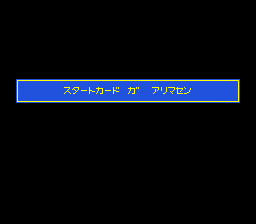
So there was nothing on it to show. Every editor screenshot in this guide is of sample part one, loaded with Data → Sample Load, or of a small novel written for the guide.
Left over in the program#
The study looked for what a reader can't reach through the menus. It found no debug screen beyond the editor's own test menu (Playing and testing), no hidden novel and no cheat. Every routine that no run reached was followed back to what calls it; none opens a screen of its own (from the code). What there is:
- The staff roll, above, and the title in sample part two's items. Part two's first five items are name items holding its title, 寺田憲史サウン ドノベル劇場 夏の樹に棲む妖精 ニンフ (後編), which its first card puts on screen with Show Item: the title card is drawn from items (The sample novel).
- The special thanks in part two's items. Fourteen more items, スペシャル02 to スペシャル15, hold the special-thanks names (the first of them deleted, its name still there). Part two never reads them, and the staff roll shows the same names from its own texts. They look like the place the names were typed before they moved to the roll's drive (inferred).
- A dead picker for music and effects. A routine of 1,167 bytes that nothing calls draws a list from two tables, an early editor's BGM and SE lists. The BGM list holds seven placeholders, names typed twice and filler (ログインソフト, アスキーアスキー, サクセスサクセス, アアアアアアアア …). The SE list has 32 effects: footsteps, men's and women's voices, thunder, rain, screams, doors opening, closing and knocked on, breaking glass, a gunshot, a shower, a telephone, wind, an engine, a car, brakes, a cut, flames, noise. It is an early plan of the final list of 256, which keeps these sounds with letter variants (Music and sound).
- A message with no caller: トウロク ガ デキマセン ? ("can't register?").
- A list of
TCpacks that no page asks for: the memory-pack code can list blocks of another kind, markedTC, but the only routine that asks for that list is never called. FATAL ERROR, the editor's first message, is a crash screen, shown when the program breaks down. It is what an item of an unknown type leads to (Limits and messages), not a debug menu.
Novels on a pack, which nothing writes. At power-on the game looks over a memory pack for two kinds of file besides its own saves, ADDM and ADRD: whole novels, which Game → Sample Game lists after the two samples and plays. Sample Load copies an ADDM into the cartridge for editing, but not an ADRD, which can only be read. Neither the game nor anything known writes them, and no such pack is known: they would have been novels sold or broadcast on a pack (inferred). The study tried both with packs it built itself (Saving and sharing).
How this study was done#
Everything in this guide comes from the program and its data: the cartridge's ROM and battery memory, read and run.
- An emulator run headless. Mesen 2, driven by scripts with no window: button presses from power-on or from saved states, memory watched and dumped, screenshots taken from the emulated screen. Every run worked on a copy of the save.
- A code/data log. The emulator marks each byte of the ROM as code or data as it runs; 39 runs over every screen marked some 64,000 bytes of code, which a disassembler written for the project reads.
- The editor as a probe. To learn what a byte means, a step or setting was made on a copy, the novel saved by leaving the editor, and the battery memory compared before and after.
- Novels written by tool. The study's tools read a drive into a script, a plain list of cards, steps, texts and items, and write a script back into a save the game plays. Novels built so opened the item and branch pages, tried each limit and error, and tested the save point; the guide's own example novel is one of them.
- Everything rebuilt byte for byte. Both sample drives, the staff roll and every save the runs made were read and written back byte for byte, which is how the study knows nothing in them is left unread.
- The font by eye and by order. The novels' 1,799 characters were read by matching each against rendered fonts and lining the kanji up with the order of the official list of everyday kanji, with every sheet looked over.
- The add-ons. The memory pack ran in Mesen with an emulated pack, the Turbo File Twin in MesenCE, a fork of Mesen that has the device. No real pack or Twin was tried. Packs holding novels or Kanadeeru's songs were built for the purpose, since none is known.
- The sequel from its disc. Sound Novel Tsukuru 2 was surveyed from its files and its program's strings, with nothing run (Compared with SNT2).
The work ran as twelve steps, each finished with its notes, a tool and a check:
| Step | What it settled | How it was checked |
|---|---|---|
| S1. The power-on check | The battery memory is one drive of the game's file system; the two sums the check makes; the prompt that formats a failing drive only when A is pressed; the cartridge's save passes and is empty | Four damaged copies, each stopped at the prompt and left unchanged until A |
| S2. The program map | The start-up, the main loop and its screens, the banks, the file system's calls | A code/data log from 39 runs: some 64,000 bytes of code seen running |
| S3. The screens | Every page, menu, setting and step command's page, in three runs | A screenshot of each, 96 in all with the later runs'; each step made, saved and read back |
| S4. Text | The novels' font of 1,799 characters, the menus' own code and font, the messages | The font matched against rendered fonts and the official kanji list's order; 93 of 95 on-screen strings found in the dump |
| S5. The drive | The file system: clusters, directory, cluster table, sums; the three ROM drives | Both sample drives and every save from the runs rebuilt byte for byte |
| S6. The novel | Cards of steps, the 30 commands, texts, items, START | Both samples and every save parsed and rebuilt byte for byte; a novel written as a script played |
| S7. Pictures | The 91 pictures and their six colour variants | Tiles, maps and palettes against the emulator's video memory, the screen pixel for pixel |
| S8. Sound | RT2's sound system, a later driver, the 60 songs, the 256 effect scripts | Every song played against the game, the track pointers the same at equal ticks |
| S9. Memory pack and Turbo File | The pack and Twin files, novels on a pack, Kanadeeru's songs as BGM 60 | A novel saved and loaded back on each; the tools' files byte for byte the game's |
| S10. The rest | Play, the save point, test mode, the limits, the hidden content | Novels built for each question and played |
| S11. Sound Novel Tsukuru 2 | The PS1 sequel, surveyed for the comparison | Its eleven sample drives checked by a tool; nothing run |
| S12. A second emulator | That none of it rests on one emulator | The same runs in bsnes: the same battery memory and screens |
A second emulator#
So that nothing rests on one emulator's quirks, four of the checks were repeated in bsnes, through a small frontend of the project's own. Each run is one script of button presses from power-on, given to both emulators unchanged, with the same save, and shots taken at the same frames:
| Run | What it does | Battery memory, Mesen against bsnes | Screens |
|---|---|---|---|
| Sample part two | From the menu to past its first save point, two minutes of play | The same, but for two bytes the power-on pack check writes; the saved reading the same in both | The same pages in the same order; 12 of 21 shots the same to the pixel, the rest within a quarter of a per cent but one |
| A two-card novel | A novel built by the study's tools, read to its end through two save points | The same but the two bytes; Mesen's result byte for byte the earlier run's | The same; the differences are fades and the menu |
| Continuing | The same novel's saved reading, continued | The same but the two bytes; the reading left alone | Both continue on the second card's sepia picture and its next text |
| A long choice | A choice text of 12 lines, laid out and answered | The same but the two bytes | The same layout, line for line, the chosen line red in both |
The two agree. The two bytes that differ are written by the power-on memory-pack check: Mesen gives the cartridge an erased pack and bsnes none, so they record the hardware, not the game. Where the screens differ, it is timing, never content: bsnes types the text about three characters ahead from the first page to the last, so the novel starts a few frames earlier and runs at the same speed; a fade is caught a frame or two apart; the main menu's wallpaper and the cursor's blink are at a different phase. Once a page is fully drawn, the two are the same to the pixel.
bsnes's memory-pack slot reads a pack but takes no writes, and it has no Turbo File, so the pack and the Twin were checked in Mesen and MesenCE only. The editor's own pages were not run in bsnes: the editor writes the drive that the tools check against Mesen's saves.
This guide's pictures and sounds are the game's own. The screenshots were taken by script in bsnes from power-on, so they can be taken again and come out the same; the four memory-pack screens are Mesen's, from the study's runs. The pictures in the catalogue are drawn from the ROM by a tool, and every song and effect is recorded from the game's playback in bsnes.
What's left open#
Sound Novel Tsukuru counts as decoded: every file a novel is made of is read and written back, and everything a novel can do has been run. These points are not settled, and none is needed to make or read a novel:
| Subject | What is not settled |
|---|---|
| Graphics | The title's packed maps drawn out; the editor's three frame types; the raster tables behind the background effects and the staging effects |
| Sound | The driver's new events compared with RT2's one by one (the songs play as the game does); some commands of the sound module called from outside the effect scripts |
| The memory pack | What a TC pack file holds (no page lists one, so it can't be tried); the sound streams a pack could carry (no such pack is known); what the boot stub in each file does in a Satellaview |
| Novels on a pack | What the ADDM and ADRD files were for: the game plays them but writes neither, and none is known (sold or broadcast novels, perhaps) |
| The editor | Its BGM list past song 59, with a pack's songs chosen; the size limits reached through the pad (they were read from the code) |
| The text | 49 marks of the novels' font not tied to a character |
| Sound Novel Tsukuru 2 | Its opcodes one by one, its item area, how its password novels start, its other picture archives; none of it run (Compared with SNT2) |
Notes/Sound Novel Tsukuru.md, Notes/Sound Novel Tsukuru/Hidden Content.md, Save.md, Second Emulator.md, Analysis Plan.md; the staff roll's script from Tools/snt_novel.py dump --drive 11; Kanadeeru's roll from Notes/Kanadeeru/Hidden Content.md, Super Dante's driver line from Notes/Super Dante/Hidden Content.md.
Fan-made reference material, one of the Eschaton Games Tsukuru guides. Not affiliated with the publishers of the titles it covers. Corrections and questions: contact@eschaton.games.