Sound Novel Tsukuru Explained#
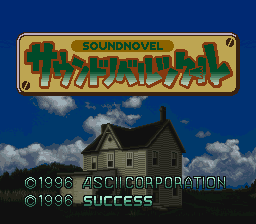
Sound Novel Tsukuru (サウンドノベルツクール) is a Super Famicom cartridge for making sound novels: stories told in text over full-screen pictures, with music and sound effects, where the reader turns the pages and now and then picks what happens next. You write the novel on the cartridge and play it there. The title screen carries © 1996 ASCII CORPORATION and © 1996 SUCCESS. The program is in Japanese only. This guide explains in English how to make a novel with it, and describes how it works inside.
A novel is made of cards. Each card is a list of steps, carried out one after another: show a picture, start a song, play a sound, type out a text, wait, offer a choice. There are 30 kinds of step in six groups (sound, graphics, text, branch, item, timer). The words themselves are texts, each with a name of its own, which the steps show. A choice sends the reader to another card, so the cards are the scenes and the choices are the forks between them. Items are the novel's memory: a flag, a number or a name that steps can set and test, so that a choice made early can change an ending later.
The pictures and the music come with the cartridge. It has 91 pictures (61 backgrounds, 2 window frames and 28 silhouettes of people, each in six colourings), 60 songs and 256 sound effects, from thunder, wind and cicadas to footsteps, sirens and screams. You can't draw a picture or write a tune of your own on it. The one way in for new music is a memory pack holding songs written in the music maker Kanadeeru. The cartridge keeps one novel of your own. Its ROM also holds a sample novel in two parts, 寺田憲史's Natsu no Ki ni Sumu Nymph (夏の樹に棲む妖精), to read, take apart in the editor and change.
Its sound comes from RPG Tsukuru 2 (RT2), ASCII's role-playing game maker on the same console: the same instruments, the same song format and a later build of the same sound driver. Its successor is Sound Novel Tsukuru 2 on the PlayStation, which kept the idea of cards of steps and rebuilt nearly everything else. Compared with Sound Novel Tsukuru 2 has the details.
A few of those numbers need a word. The space is shared: every card and every text takes at least one 128-byte block of the 425, so a novel of many small texts fills up sooner than one of few long ones (Limits). There is one saved reading: when a novel reaches a save point, the cartridge remembers where the reader is, but only one place for one novel at a time (Playing and testing). And a number item can be set and compared but not counted up: the editor offers plus and minus, but the cartridge ignores them (Limits, bugs and messages).
The cartridge#
| Title | サウンドノベルツクール (Sound Novel Tsukuru, "Sound Novel Maker") |
|---|---|
| Code | SHVC-ZSNJ |
| Copyright | © 1996 ASCII CORPORATION, © 1996 SUCCESS (the title screen) |
| Made by | Success, for ASCII |
| ROM | 3 MB: the program, the pictures, the music and the recorded sounds, the sample novel and the staff roll |
| Save | 64 KB of battery-backed memory: one novel, the one saved reading, and the settings |
| Slot | A Satellaview memory-pack slot |
| Input | The pad. A Turbo File Twin plugs into the second controller port |
The cartridge studied for this guide came second-hand. Its save passes the cartridge's check and holds no novel (Behind the scenes).
About this guide#
This is an original English guide. No manual or guidebook was at hand, so it cites none. It was written from a preservation project's study of the program itself. The study read the cartridge's code and decoded its formats: the save and the cartridge's own file system, the novel (cards, steps, texts and items), the player, the text and fonts, the pictures, the sound, the memory pack and the Turbo File. It drove every screen in the Mesen emulator and checked what each step writes into a novel. It wrote novels of its own with a tool, played them in Mesen, and played them again in a second emulator, bsnes, which agreed. How it works describes the inside, and Behind the scenes describes the study.
Where the study read something from the code without seeing it happen, the guide says so. Where it couldn't settle a question, the guide leaves it out rather than guess.
Some boxes compare Sound Novel Tsukuru with its successor, or with the other ASCII cartridges it shares parts with:
Other boxes give tips for making novels, or describe a trap and how to avoid it.
The pictures and sounds#
- Screenshots were taken in bsnes by a script, from power-on, so they can be taken again with the same result. The editor's are of sample part one, loaded into the editor, or of a small example novel written for this guide. The memory-pack screens come from Mesen, the one emulator here with a working memory pack. Key screens have numbered labels with an English key underneath.
- The pictures in the catalogue are drawn straight from the ROM, in all six colourings.
- The sound clips are the cartridge's own playback, recorded in bsnes: each song from its start, each effect as a novel plays it.
The program is Japanese only, so every screen appears as the game draws it. The guide gives each label in English with the Japanese beside it the first time, for example Cards カード. The glossary collects them all.
The chapters#
Start here#
Making a novel#
Catalogue#
Reference#
What you need#
- The cartridge: Sound Novel Tsukuru, SHVC-ZSNJ, on a Super Famicom or in an emulator that runs Super Famicom games. Novels play the same in Mesen and in bsnes.
- A pad. Everything is done with the pad; there is no mouse (Getting started).
- Some patience with Japanese characters. The menus are in katakana. This guide translates each one. Names of cards, texts and items can be typed in capital letters and digits, and a text can use A–Z and a–z as well as kana and kanji (Texts).
- Care with a second-hand cartridge's save. If the save fails the cartridge's check at power-on, the cartridge offers to erase it and waits for A. Nothing is written until then. Copy the save with a cartridge reader first (Keeping the save safe).
- For more than one novel (optional): a Satellaview memory pack in the cartridge's slot holds eight, and a Turbo File Twin on the second controller port holds three, as space allows. In emulation, Mesen has the memory pack and MesenCE the Twin (Saving and sharing).
- For music of your own (optional): the music maker Ongaku Tsukuru Kanadeeru and a memory pack. Its songs, converted to the pack, play in a novel as songs 60 and up (Music and sound, and Kanadeeru's guide).
Fan-made reference material, one of the Eschaton Games Tsukuru guides. Not affiliated with the publishers of the titles it covers. Corrections and questions: contact@eschaton.games.